
What an Independent University Study Revealed About School Zone Speed Safety Programs
August 17, 2026
Verra Mobility and Hertz Expand Technology Partnership Under Renewed Contract
August 26, 2026
By Stacey Moser, chief customer officer, Verra Mobility
We often talk about road safety in terms of statistics. But behind every number is a person: a parent walking a child to school, a construction worker making a living, or a cyclist commuting to work.
Throughout my career, I’ve worked with agencies that make incredibly difficult decisions about roadway safety. While every community is different, one priority is universal: protecting people.
That is why roadway safety decisions deserve careful consideration, especially when they involve tools that have demonstrated an ability to influence driver behavior.
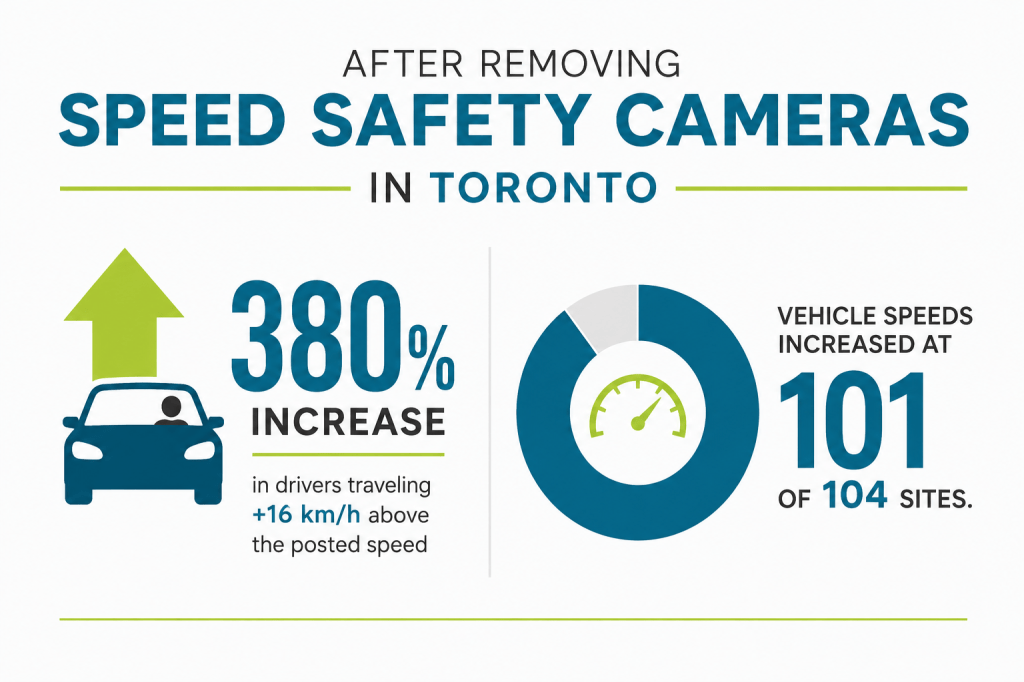
Recent reporting from Ontario offers an important reminder and lessons for communities everywhere. After automated speed enforcement cameras were removed, cities began documenting significant increases in speeding. In Toronto, the number of drivers traveling 16 km/h or more above the posted speed limit increased by approximately 380 percent. Vehicle speeds increased at 101 of 104 monitored locations, and the percentage of drivers traveling 11 km/h or more over the speed limit rose from 2 percent to 8.1 percent.
These findings deserve our attention.
This isn’t about one province or one policy decision. It’s about what happens when driver behavior changes, and what every community can learn from that data.
Speed changes behavior, and so does accountability
For decades, transportation professionals have understood the simple truth that speed matters.
As vehicle speeds increase, stopping distances grow longer, crashes become more severe, and vulnerable road users face dramatically greater risk.
Automated speed enforcement has never been about issuing more citations. The goal is to encourage drivers to slow down before a crash ever occurs. Drivers respond to consistency and accountability. When accountability is visible, speeds come down, but once it’s removed, driver behavior can change quickly.
One of the most encouraging measures of a successful roadway safety program is that drivers become safer over time. Fewer violations mean more drivers are slowing down. That’s the outcome communities should want because the objective isn’t enforcement for its own sake. It’s behavior change.
Every community faces challenges
Every transportation agency is balancing competing priorities: safer streets, efficient transportation, public trust, and responsible stewardship of taxpayer resources. These objectives are not in conflict.
The most successful roadway safety programs recognize that automated enforcement is not a standalone technology. It is one component of a comprehensive safety strategy that also includes roadway design, public education, transparent policies, engineering improvements, and community engagement. A single solution does not eliminate speeding, but a combined effort can make real, measurable improvements.
The experience from Ontario reminds us that removing proven safety tools without understanding the behavioral consequences can create unintended risks.
Public trust matters
Public trust doesn’t happen automatically. It has to be earned through transparency, consistency, and public education. Communities deserve to understand why programs exist; drivers deserve clear signage and consistent rules, and every enforcement event should be accurate, reviewable, and administered with integrity.
When these principles guide implementation, automated enforcement becomes much larger than a camera. It becomes a public safety program designed to encourage responsible driving and protect the people who use our roads every day.
A reminder to all
Ontario’s experience should not be viewed as an opportunity for criticism; it should be viewed as an opportunity for reflection and as a lesson learned for other cities.
I’ve had the privilege of working with transportation leaders across North America, and I’ve never met one whose goal was to issue more citations. Their goal is always the same: reduce speeding, prevent crashes, and make their communities safer. The best programs are measured not by how many violations they generate, but by how quickly dangerous driving declines.
That’s why conversations about automated enforcement should always begin with safety. Focus on what matters: protecting people. When communities encourage drivers to slow down, they create safer streets, stronger public confidence, and more opportunities for everyone to arrive home safely.