

Cities of Glendale and Long Beach select Verra Mobility to implement speed safety programs
January 29, 2026
Mobility In 2026: The Year Cities Catch Up With AI And AVs
February 3, 2026

Every school day, millions of children walk, bike, or ride buses to class, but for many parents and caretakers, the journey to school feels increasingly dangerous for their children. A recent survey distributed by Pollfish highlights the top concerns around student transportation.
The survey, which included 2,000 parents or caretakers of children who walk, drive, are driven, or take transportation to school, showed that many respondents have witnessed near-miss incidents and overwhelmingly support automated enforcement measures to protect students from reckless drivers and prevent tragic accidents.
Parents Strongly Support Automated Enforcement Cameras
The message from parents is clear: automated enforcement is an important tool for student safety.
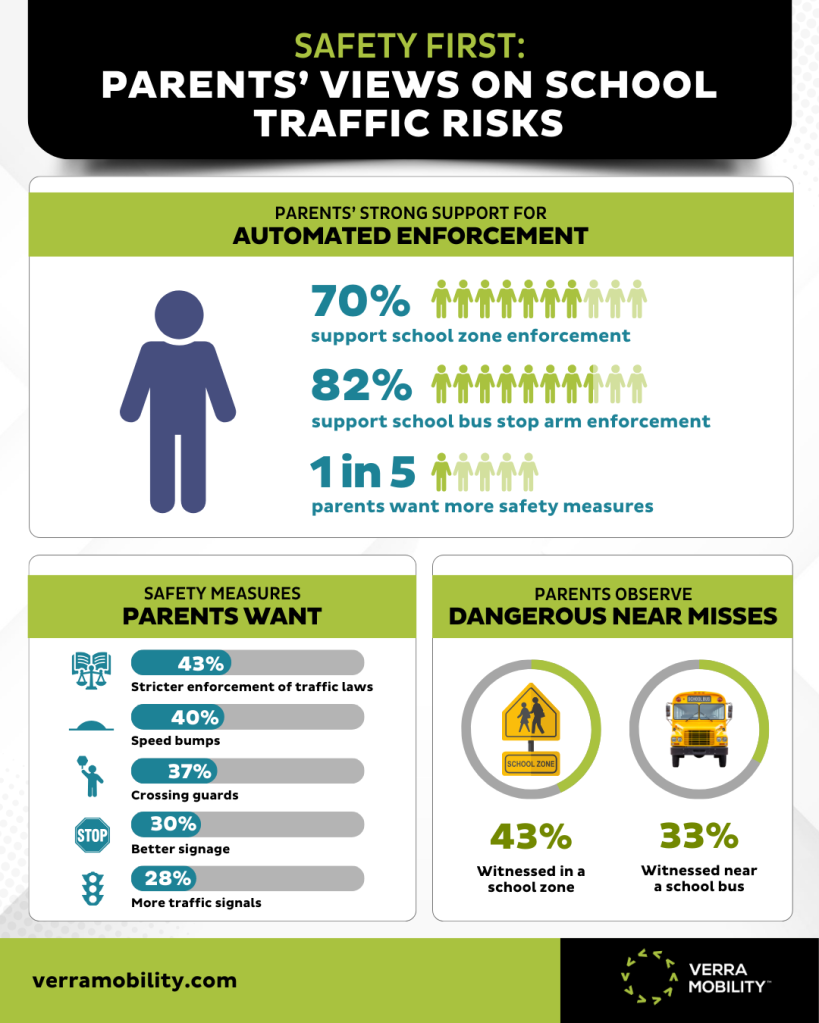
- 70% of respondents favor automated enforcement in their community’s school zones
- 82% support safety cameras to monitor and penalize drivers who illegally pass stopped school buses
These numbers indicate that parents are increasingly trusting technology to enhance enforcement efforts and keep children safe.
A Holistic Approach to Student Safety
While automated enforcement is a top priority, parents and caretakers want a range of physical and policy-based improvements to make school zones safer:
- 40% support installing speed bumps to slow vehicles near schools
- 37% want more crossing guards to help children navigate busy intersections
- 30% call for better signage to alert drivers to school zones
- 28% advocate for additional traffic signals to improve pedestrian safety
These findings show that parents want a multi-pronged approach, combining technology, infrastructure, and human oversight to protect students.
Why Enforcement Matters
Parents’ advocacy for more safety measures is based on experience, with many parents and caretakers having seen the risks firsthand:
- 43% have observed a “near miss” in a school zone
- 33% have seen a “near miss” near a school bus with its stop arm extended
The top concern, cited by 65% of respondents, is reckless drivers, noted as the biggest threat to school transportation safety. Speed is one of the most critical factors in pedestrian safety, especially for children. Research indicates that the likelihood of severe injury rises dramatically with speed:
- At 20 mph, there’s about an 18% chance of severe injury.
- At 30 mph, that risk jumps to 50%.
- At 40 mph, it skyrockets to 81%.
In school zones, where children may cross unpredictably, even a few extra miles per hour can mean the difference between life and death. Automated speed enforcement helps ensure drivers slow down, creating a safer environment for students.
School leaders share these concerns: 38% of public-school officials moderately or strongly agree that traffic patterns around their schools pose a threat to students’ physical safety during their commute.
Reckless driver behavior around school buses puts children at risk of being hit while boarding or departing the bus. According to the National Association of State Directors of Pupil Transportation Services (NASDPTS), it is estimated that more than 39 million illegal passings of stopped school buses occurred during the 2024–2025 school year.
How Communities are Responding
Cities and counties across the U.S. are taking action. During the 2024-2025 school year, Verra Mobility launched 13 new school zone speed programs, including Fairfax County, VA, and Memphis, TN, to deter dangerous driving and protect students. In addition, five states passed new legislation to address illegal school bus crossings just last year.
These efforts are already changing driver behavior. Verra Mobility has found that 98% of drivers who receive one stop-arm violation do not receive another. Some programs have seen as much as a 67% drop in citations from the start to the end of the school year.
Additionally, New York City saw an approximate 14% drop in injuries and a nearly 20% drop in crashes involving children one year after implementing a school zone speed program.
This adoption of automated enforcement programs aligns with what parents want, as the survey reveals that 45% of parents and caregivers support stricter enforcement of traffic laws to help better protect students as they travel to and from school.