

The Future of Smart Mobility: How Connected Vehicles Are Shaping Intelligent Transportation Technology
June 17, 2026
Back-to-School Means More Traffic – It Doesn’t Have to Mean More Risk
July 1, 2026
Summer has long been associated with increased roadway risk. Warmer weather, long weekends, and a surge in travel all contribute to higher traffic volumes and, historically, more crashes. National data consistently shows that summer months bring some of the highest rates of roadway fatalities, driven in part by more miles traveled and more time spent behind the wheel.
Verra Mobility analyzed data from hundreds of communities across the U.S., suggesting that volume alone isn’t the full story. Driver behavior is shifting, and not in a safer direction.
Speeding is Rising Across Summer Holidays
Over the “100 Days of Summer,” the approximate 100-day period between the start of Memorial Day weekend and the end of Labor Day weekend, often associated with increased road safety risk, speeding violations were at their highest level in 2025, up 54% from 2024, which showed a slightly lower number of violations compared to 2023.
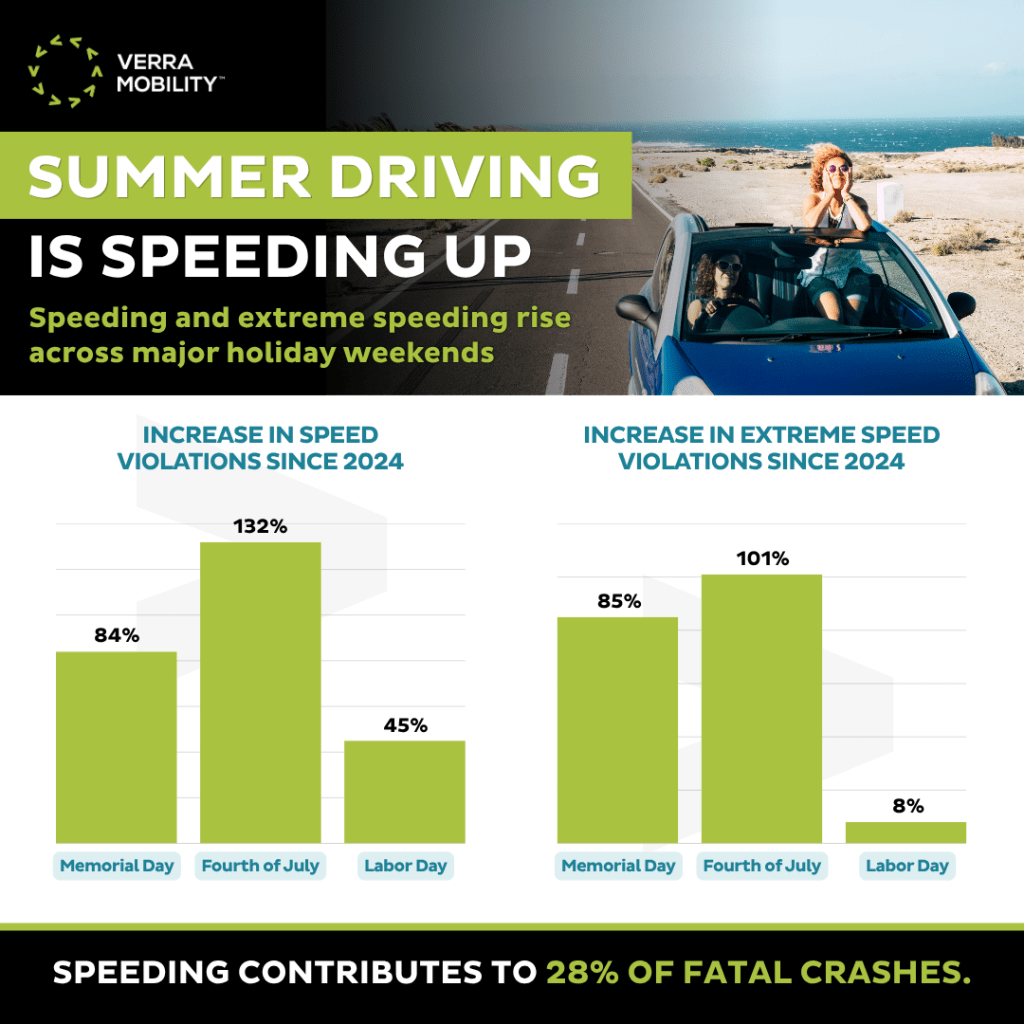
Across the three major summer holiday weekends, Memorial Day, the Fourth of July, and Labor Day, speeding is rising, and in 2025, it reached the highest levels observed in recent years across every holiday weekend analyzed. Memorial Day weekend saw a staggering 84% increase in speeding compared to 2024, while Labor Day weekend saw a 45% increase.
The most dramatic change, however, occurred over the Fourth of July weekend. Speeding during that period surged 132% compared to 2024, the largest jump across the dataset. Among all summer travel periods, the Fourth of July now stands out as the most pronounced spike in risky driving behavior when factoring in increases in distracted driving and the prevalence of drinking and driving.
The trend becomes even more concerning when looking at high-speed violations, where drivers exceeded the limit by more than 20 miles per hour. Over the entirety of the “100 Days of Summer,” high-speed violations increased 44% compared to 2024.
The increase was more dramatic during peak travel windows. Fourth of July violations climbed over 100% from 2024, reaching the highest level across all holidays measured. Memorial Day weekend also saw an increase, with high-speed violations returning above 2023 levels after declining the previous year. Labor Day weekend remained more stable, though still trending upward with an 8% increase.
This matters because speeding remains one of the most significant contributors to roadway fatalities. In 2023, 28% of all fatal crashes were speeding-related, and data shows how even incremental increases in speed can have deadly consequences.
Red-Light Violations Rise During Holiday Weekends
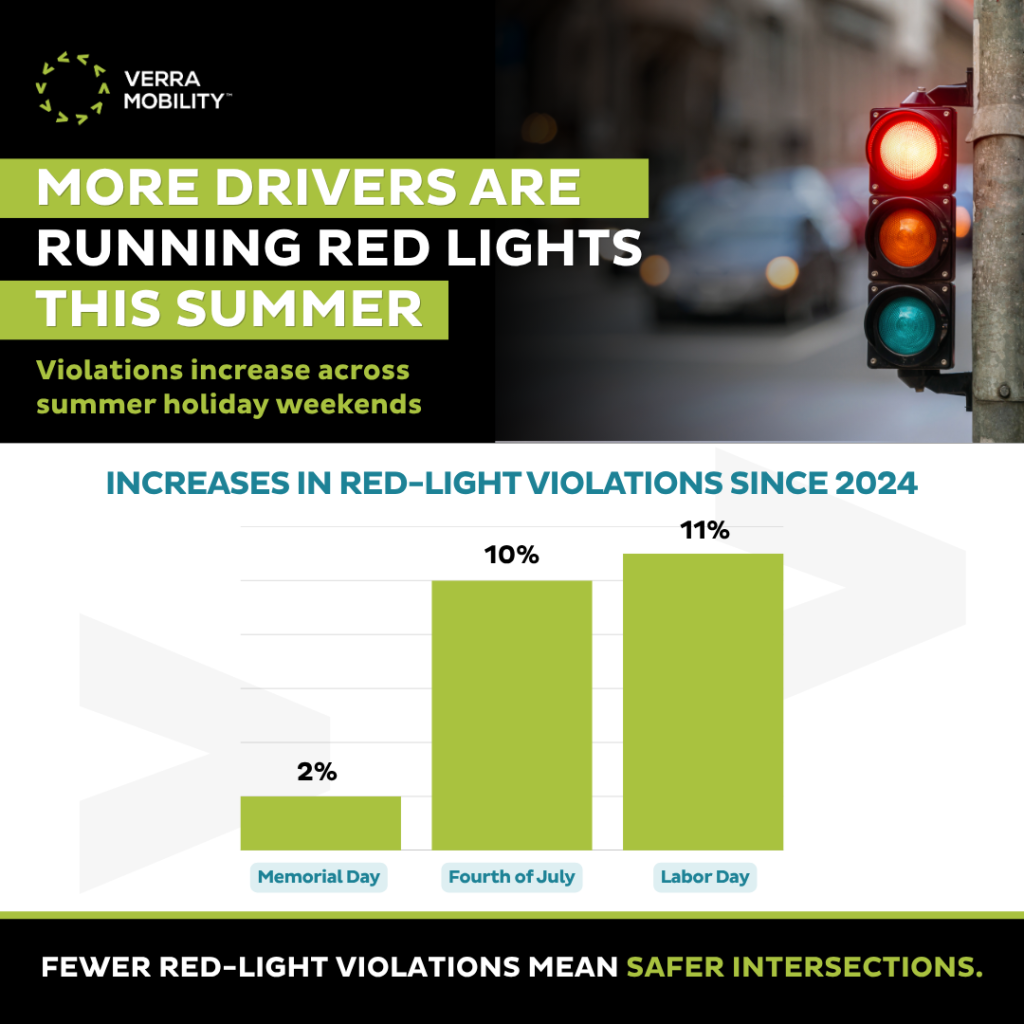
Red-light violations tell a more nuanced story than speeding. Overall, violations remained relatively stable, increasing just 1.6% compared to 2024 and decreasing 4% compared to 2023. While these changes are far less dramatic than the increases observed in speeding, they do not tell the full story.
During holiday weekends, red-light violations rose more noticeably. Memorial Day weekend saw a 2% increase compared to 2024, while Fourth of July and Labor Day weekends experienced increases of 10% and 11%, respectively.
Although intersection compliance has generally held steady, the concentration of red-light violations during major holiday travel periods remains concerning. These spikes, combined with rising speeds, suggest that risky driving behaviors become more common when roadway demand is at its highest.
Speed is Amplifying Summer Travel Risk
Summer travel amplifies crash risks. More drivers are on the road, trips are longer, and congestion ebbs and flows around peak holiday windows. In those conditions, higher speeds carry greater consequences. Even small increases in average speed can significantly affect stopping distance and crash severity, while extreme speeding dramatically raises the likelihood of fatal outcomes.
The data points to a shift that requires drivers’ attention. Roads are not just busier in the summer; they are also faster, and that speed often concentrates when traffic volumes are at their highest.
The “100 Days of Summer” has always been a critical period for roadway safety. What’s changing is the nature of the risk. As travel continues to increase, the challenge is no longer just managing volume but addressing the behaviors that come with it. Slowing down remains one of the most effective ways to reduce crashes and save lives, and the latest trends suggest that message is more important now than ever.