

Why Stopping on Red Matters as Micromobility Grows
August 6, 2026
What an Independent University Study Revealed About School Zone Speed Safety Programs
August 17, 2026

After years of rising roadway deaths, the U.S. is beginning to see signs of progress.
NHTSA estimates that traffic fatalities declined to 36,640 in 2025, down 6.7% from 2024, even as vehicle miles traveled increased. However, with more than 36,000 lives lost in a single year, one thing is clear: there is still significant work ahead.
Verra Mobility’s new white paper, The Next Era of Road Safety: How Modern Technology, Policy and Public Trust Will Define the Future Beyond Vision Zero, examines the future of road safety from multiple angles, from state policy to autonomous vehicles, AI, and lessons from communities in the U.S. and abroad. It also highlights real-world examples of how transportation leaders are combining technology, policy, public education, and transparent program design to address specific roadway risks.
One of the most persistent challenges facing communities: changing driver behavior.
Speeding, distraction, red-light running, and illegal passing of stopped school buses remain difficult behaviors to address through education and infrastructure alone. For example, the report notes that speeding contributed to 28% of all traffic fatalities in 2022.
Public attitudes illustrate the complexity of the challenge. In Verra Mobility’s 2025 distracted-driving survey, 85% of respondents said distracted driving is as dangerous as, or more dangerous than, drinking and driving, while 63% said the average driver has gotten worse in recent years.
The white paper looks beyond today’s roadway safety challenges to examine the policies, technologies, and practical lessons that could shape what comes next.
Readers will explore:
- What is working in U.S. communities. Examples from Washington, D.C., San Francisco, Hawaii, Atlanta, Philadelphia, and Pittsburgh show how communities are applying different combinations of policy, technology, public education, and enforcement to address local safety challenges.
- What the U.S. can learn from other countries. International experience shows how sustained progress can come from layering speed management, safer infrastructure, consistent policy, public education, and other interventions over time.
- How autonomous vehicles, connected vehicles, and AI could reshape road safety. Emerging technology creates new opportunities to identify risks and help prevent crashes, as well as new questions about governance, data sharing, and human oversight.
- Why driver behavior remains one of the hardest variables to change. The report examines speeding, distraction, red-light running, and illegal school bus passing, along with approaches designed to encourage safer behavior.
- How policy can enable safer, more trusted programs. State laws determine which tools communities can use and how programs address civil penalties, privacy, human review, warning periods, and other safeguards.
- Why data, privacy, and public trust matter. Modern safety programs increasingly depend on data, but transparency, clear rules, equitable deployment, and accountable oversight are essential to earning community confidence.
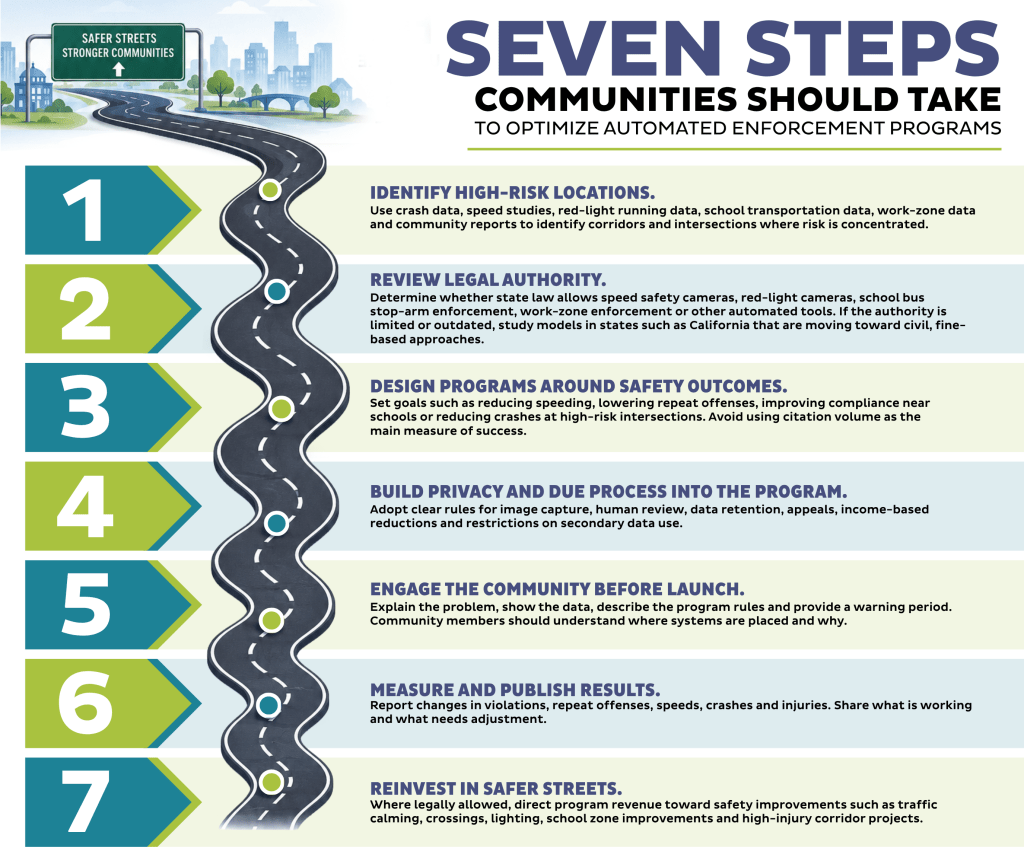
In the white paper, you’ll find helpful resources like the seven steps that communities should take before starting a road safety program:
Click here to download the white paper to learn how communities can build on recent progress and advance roadway safety through thoughtful policy, modern technology, behavior change, and public trust.