

One in Three Americans Cite Crashes as Top Safety Concern: New Data Offers Reason for Optimism
September 8, 2026
Connected Vehicle Services That Make Driving Easier: From Tolling to Fueling and Beyond
September 28, 2026
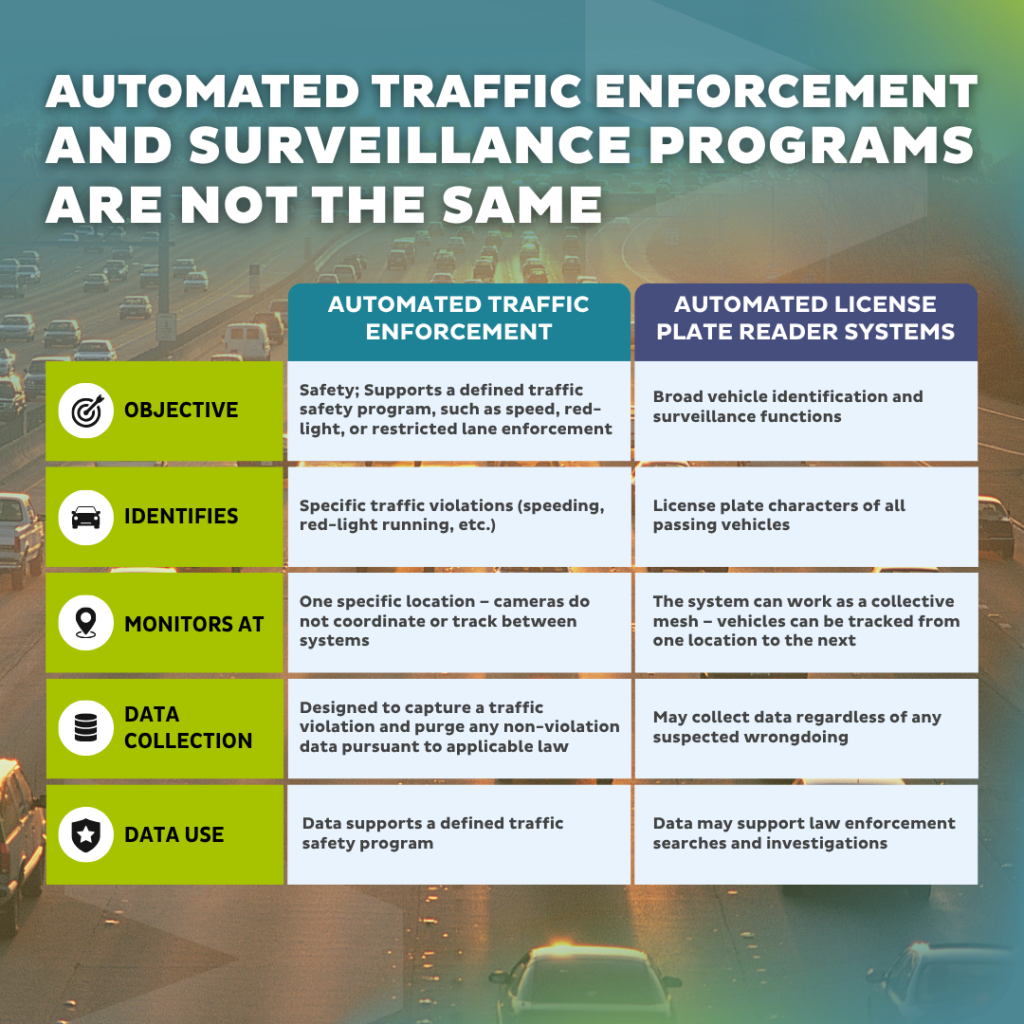
Recent public debate around automated license plate reader networks has raised important questions about cameras, license plates, and privacy. While automated license plate reader (ALPR) systems and automated traffic enforcement safety programs both use cameras and license plate recognition technology, they are very different programs.
ALPR systems are generally designed to help law enforcement identify and locate vehicles. Depending on how a system is configured and governed, cameras can capture license plate information from vehicles passing within their field of view, creating records that can subsequently be searched for investigative purposes.
Automated traffic enforcement works differently.
Speed, red-light, school bus stop-arm, and similar automated safety programs are designed around a specific roadway behavior defined by law. The system identifies an event such as speeding, entering an intersection against a red light or illegally passing a stopped school bus. Evidence associated with the alleged violation is then processed in accordance with the requirements of the jurisdiction.
For Verra Mobility programs, the technology is configured to execute the specific safety program authorized by the customer and applicable law. It is important to know that the data belongs to the customer, and that privacy is a top priority. Verra Mobility does not sell personal data and applies safeguards including role-based access, data minimization, retention requirements and security controls.
Put simply, license plate recognition may be a component of both technologies, but the purpose, collection model, and rules governing the resulting data can be fundamentally different.
An independent privacy perspective
This distinction is not simply Verra Mobility’s position. An independent civil liberties organization known for its focus on privacy published an article specifically comparing license plate readers with automated traffic enforcement.
Its conclusion was notable: when properly regulated, automated traffic enforcement does not present the same privacy concerns as license plate reader surveillance.
The article explained that ALPR systems can capture information about motorists regardless of whether they are suspected of wrongdoing, while automated traffic enforcement is designed to collect information associated with specific alleged traffic violations. The organization also emphasized the importance of strong rules governing collection, retention, access and use of automated enforcement data.
The goal of automated enforcement is behavior change
The distinction becomes even clearer when looking at how successful automated traffic enforcement programs are measured.
The objective is not to collect information about where motorists travel. It is to encourage compliance with traffic laws and reduce dangerous driving behavior.
Evidence from government agencies and existing programs demonstrates that automated enforcement can produce substantial changes:
- 93% reduction in speeding and 50% fewer traffic fatalities. Philadelphia reported an approximately 50% reduction in traffic fatalities during the first seven months of automated speed enforcement on Roosevelt Boulevard. Monthly speeding violations declined 93% from June 2020 to January 2022.
- Significant reductions in red-light running. Federal Highway Administration research found reductions of as much as 60% in red-light-running violations at intersections using automated cameras. Separate U.S. DOT research reported a 48% reduction for violations occurring at least one second after a light turned red.
- 98% of drivers receiving a Verra Mobility Stop Guard™ violation do not repeat the offense. Verra Mobility program data from the 2024-25 school year also shows nearly a 70% reduction in citations over the school year.
These results point to the intended outcome: fewer violations over time. That is an important measure of whether a roadway safety program is actually changing behavior.
Privacy and safety should work together
Communities should ask questions about any technology that collects vehicle information. They should understand what is collected, why it is collected, who can access it, how long it is retained and what safeguards govern its use.
Those questions strengthen responsible public programs.
But discussions about ALPR networks should not automatically be applied to every camera operating along a roadway. A system designed to create searchable records of passing vehicles is fundamentally different from a regulated safety program that documents a specific traffic violation.