
Back-to-School Safety Tips for Families
July 1, 2026
Midyear Toll Update: What Fleets Need to Know About Rising Toll Costs in 2026
July 27, 2026
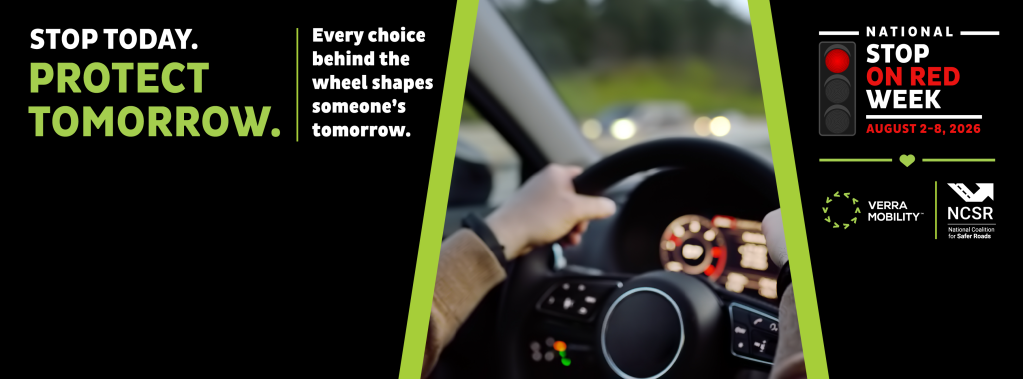
Every time a driver approaches a red light, they make a potentially life-changing decision. Most of the time, the impact of that decision lasts only a few seconds, but in some cases, it can lead to devastating consequences that last a lifetime.
That’s the message behind National Stop on Red Week, observed annually to raise awareness about the dangers of red-light running. This year’s theme: Stop Today. Protect Tomorrow., reminds us that one responsible choice behind the wheel can help prevent a lifetime of loss.
Verra Mobility is proud to join the National Coalition for Safer Roads (NCSR) and communities across the country in recognizing National Stop on Red Week and encouraging every driver to make safe decisions at intersections.
“National Stop on Red Week is more than a campaign; it’s a call to action. Every time we approach an intersection, we have an opportunity to make a choice that can protect lives and prevent serious injuries. Stopping at a red light may seem like a small decision, but its impacts are far-reaching. Every safe stop helps ensure that a parent, a child, a friend, a colleague, or a neighbor makes it home safely. Real progress happens when we all embrace our role in creating safer roads by inspiring better choices and raising awareness to make every intersection a safer place. By choosing to stop today, we help protect tomorrow and move closer to a future where every journey ends safely.”
Melissa Wandall, president of the National Coalition for Safer Roads
The Urgency Behind National Stop on Red Week
Red-light running is claiming more lives. According to data from the Insurance Institute for Highway Safety (IIHS), fatalities involving a red-light runner have increased by nearly 60% over the past decade, rising from 711 deaths in 2014 to 1,119 in 2024. Red-light-running crashes also account for a growing share of all traffic fatalities.
In 2024 alone, red-light-running crashes killed more than 1,000 people and injured more than 141,000 others. The problem extends far beyond those behind the wheel, as nearly half of those killed are pedestrians, bicyclists, passengers, or occupants of other vehicles, not the driver who ran the red light.
The numbers are alarming, but they only tell part of the story. Behind every statistic is a person, a family, and a community forever changed by a preventable decision.
Julie Nicholson’s Story
In 2020, Julie Nicholson was out for a run in San Francisco’s Golden Gate Park when a speeding driver ran a red light, crashed into another vehicle, and was propelled into the park, striking Julie head-on.
“My life changed in an instant,” Nicholson said. “There was a car that was racing, speeding down a hill in San Francisco, and recklessly ran a red light, hit another car, and was speeding so fast the driver could not control his car. When he ricocheted off the car, he came into the park straight toward me and hit me head-on. It was absolutely terrifying. I was thrown about 20 feet. I broke my neck and my back, but thankfully, after a year of recovery, I survived.”
Julie considers herself one of the fortunate ones.
“I know many, many families are not as fortunate as myself, and I’m very grateful every day for the breath that I take. This is why I share my story – no family should lose a loved one, no individual should lose their own life because somebody chose to speed and run a red light.”
Today, Julie is an advocate with Families for Safe Streets, using her experience to encourage safer driving so that others never have to endure what she did.
Jefohn Jefferson’s Story
For Jefohn Jefferson, the consequences of one reckless decision have lasted a lifetime.
When Jefohn was just five years old, his father was killed by a reckless driver. He has grown up with the lasting impact of losing a parent to a preventable crash and now encourages others to drive safely.
“You’re risking your own life and someone else’s life when you run a red light or drive recklessly. You’re breaking the law and could be pulled over or arrested. If you get in an accident, you could kill someone or yourself. It’s very dangerous. Try to be as safe as possible.”
Jefohn’s story is a reminder that traffic crashes don’t end when emergency responders leave the scene. Their effects ripple through families, childhoods, and communities for years to come.
Creating Safer Intersections Together
Stories like Julie’s and Jefohn’s are powerful reminders that preventing red-light running requires communities committed to improving intersection safety.
Across the country, communities are using public awareness campaigns, road safety improvements, and automated traffic safety programs to reduce dangerous driving and improve compliance at intersections. More than 333 communities in the United States now use red-light safety cameras, and research has shown these programs can reduce fatal red-light-running crashes in large cities by 21%. Unfortunately, the data also shows that communities that have removed red-light cameras have experienced a 30% increase in fatal red-light-running crashes.
While no single solution can prevent every crash, every driver can make a choice that contributes to safer roads.
This National Stop on Red Week, join Verra Mobility and the National Coalition for Safer Roads in committing to stopping preventable red-light fatalities. Help educate those in your community, stay alert behind the wheel, and always stop at red lights.